
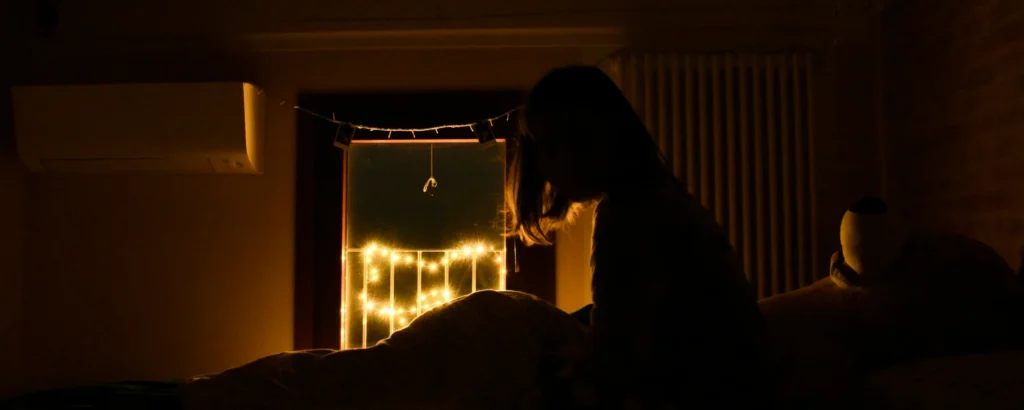
The lights are off. The day is over. There’s nothing left to decide, nothing left to fix, nothing left to do except close your eyes. And that’s exactly when it starts, not the big obvious worries, but the small strange ones. A comment from a meeting eight months ago. Whether you locked the car.
A conversation you had in your head with someone who wasn’t there for the actual argument.
None of it showed up at 2pm, when you had actual free time to think about it. It waited. It always waits.
What the Spiral Usually Sounds Like
The nighttime version of overthinking has a pretty recognizable shape, once you notice it:
- A memory from years ago shows up uninvited, fully detailed, for no reason you can identify.
- Small, solvable problems, an email you need to send, a chore you forgot, suddenly feel urgent at an hour when you can’t do anything about them anyway.
- You rehearse conversations that haven’t happened yet, sometimes with people you’re not even upset with.
- You replay a single word someone used earlier in the day and analyze it until it somehow means five different things.
- The moment you notice you’re spiraling, you start a second spiral about how you really need to fall asleep, which somehow makes it worse.
It’s rarely about anything that’s actually urgent. It just feels urgent, because there’s finally room for it to speak.
Why Your Brain Picks Nighttime
There’s a real reason your mind saves its loudest material for the one time of day you least want it. Neuroscientists have identified something called the default mode network, a set of brain regions that becomes more active when you’re not focused on an external task. During the day, conversations, screens, decisions, and other people’s needs constantly interrupt that network. At night, with the external noise gone, it finally gets uninterrupted airtime. It fills that space with whatever you’ve left unprocessed beneath the day’s actual agenda.
Sleep researchers studying insomnia call the related experience pre-sleep cognitive arousal, the mind staying mentally activated right when the body is trying to power down. Nighttime is not creating new problems. Nighttime gives your thoughts the first quiet room they’ve had all day. They use it exactly the way you’d expect anything to behave once you finally let it speak.
It’s Not a Bigger Problem, Just a Quieter Room
None of this means the thought that’s keeping you up is more important than it seemed earlier. It usually means the opposite. It’s just the first moment all day where nothing was competing for its attention. The same worry that felt manageable at noon can feel enormous at midnight, not because anything changed about the worry, but because everything changed about the volume around it.
That’s worth remembering in the moment: your brain isn’t giving you new information at 2 a.m. It’s bringing old information back to the surface. You finally have enough quiet to hear what you pushed aside during the day. It doesn’t need solving right now. It mostly needs acknowledging, and permission to wait until there’s daylight and an actual task list to attach itself to.
If your nights have a habit of sounding like this, you’re deep in Overthinkers territory, the same mind that reruns conversations by day is usually the one running the late show too. “It kept going” was named for exactly this, the thought that doesn’t clock out just because the day technically did.